English
 français
 Deutsch
 Español
 italiano
 русский
 português
 中文
中文
×
The manufacturing floor is not a place for fragile electronics. Dust, water, impact, and extreme temperatures conspire against consumer-grade devices, which is why rugged tablet computing has moved from a niche luxury to an operational necessity across sectors like factory automation, oil and gas, logistics, and field services. This guide walks through the critical factors engineers and procurement teams should weigh when selecting a rugged tablet—and how Geshem's product line addresses the most demanding industrial scenarios.
Consumer tablets fail in industrial environments. The numbers make this obvious: according to VDC Research, the average annual failure rate for consumer-grade tablets in manufacturing environments exceeds 38%, while rugged devices hover around 4%. That gap translates directly into downtime, replacement costs, and safety incidents.
A rugged tablet is built from the ground up to survive conditions that would destroy a standard iPad or Surface. But "rugged" isn't a binary label—it exists on a spectrum defined by internationally recognized standards.
The IP rating system tells you exactly how well a device resists solids and liquids. The first digit covers dust and particle ingress; the second covers water.
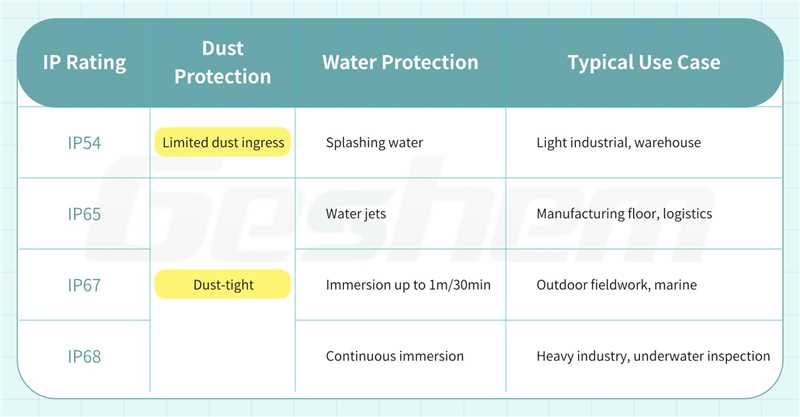
For most factory automation deployments, IP65 represents the minimum acceptable standard. Geshem rugged tablet models rated IP67 provide the extra margin needed for washdown environments—food processing, pharmaceutical manufacturing, and chemical plants where equipment is regularly hosed down.
Military-grade standard 810G (and its successor 810H) subjects devices to a range of environmental stress tests, including drop, impact, vibration, extreme temperatures, humidity, and salt spray. A true rugged tablet should pass at least drop and vibration tests.
Geshem's industrial computer and tablet product lines are tested to MIL-STD-810G/H standards, covering an operating temperature range of -20°C to 60°C.
Industrial tablets don't have the luxury of active cooling fans. Everything runs on passive thermal designs, which means processor selection is a balancing act between compute power and heat dissipation.
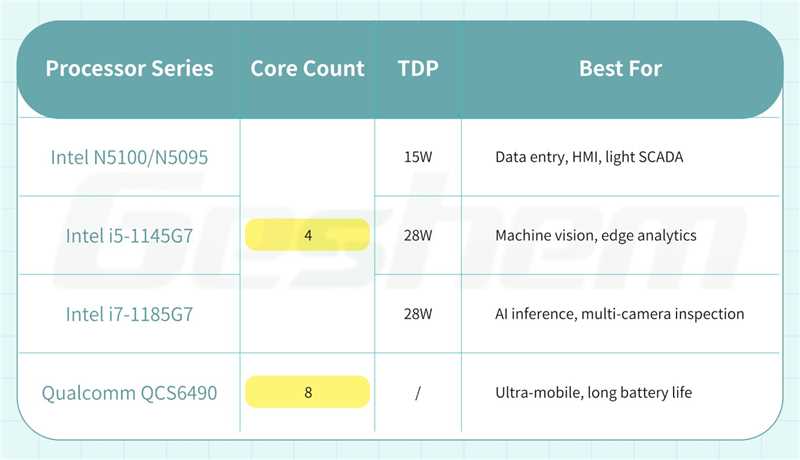
The takeaway: don't over-spec the processor. A tablet running HMI software on a factory floor doesn't need an i7. Match the compute platform to the actual workload, and you'll get better battery life and thermal performance as a bonus.
Industrial operators work under harsh lighting—direct sunlight, dim warehouses, or transitional zones. Three display factors determine whether a tablet is actually usable:Brightness, Touch Technology, Screen Size.
Battery life in rugged tablets is a logistics issue, not just a convenience issue. When a technician is 40 feet up on a cell tower or inside a confined space in a chemical plant, a dead battery means climbing down, swapping, and climbing back up—costing 15-30 minutes per swap.Key battery features to demand:
Minimum 8-hour continuous operation under typical workload
Hot-swappable battery design (swap without powering down the device)
Wide-range charging (vehicle docks, standard USB-C PD, desktop cradles)
Geshem rugged tablet models support dual-battery hot-swap configurations, allowing continuous 24/7 operation in shift-based environments common in factory automation and process control.
A rugged tablet without reliable connectivity is an expensive paperweight. Industrial environments are notoriously hostile to wireless signals—metal walls, electrical interference, and concrete structures create dead zones and signal degradation.
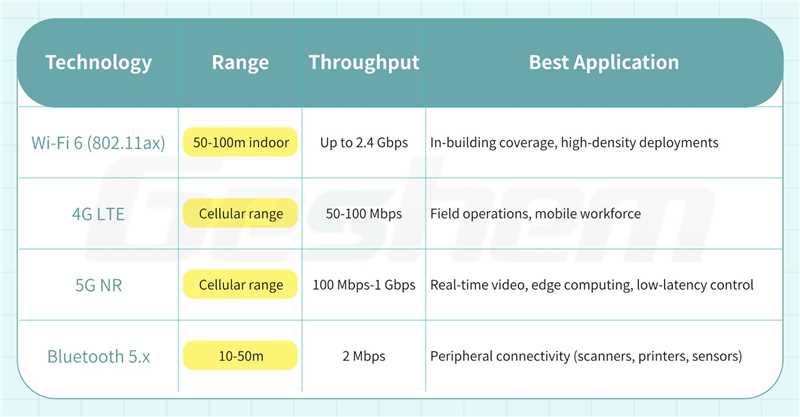
For factory automation specifically, Wi-Fi 6 with roaming optimization (802.11k/v/r) is essential. Geshem rugged tablet models support enterprise-grade Wi-Fi 6 with fast roaming, ensuring seamless handoff between access points as operators move through the facility—a critical requirement when the tablet is running real-time SCADA or process control applications.
When a rugged tablet doubles as a panel PC replacement or is mounted in a vehicle dock, wired connectivity becomes relevant. Look for:
USB-C with Thunderbolt 4 for high-speed peripheral and display connections
RJ45 Ethernet (direct or via dock) for hardwired network access
RS-232/422/485 serial ports for legacy industrial equipment integration
The Geshem panel PC and embedded PC product lines offer native serial port support, while the rugged tablet series provides serial connectivity through docking stations—bridging modern mobile computing with legacy industrial infrastructure.
The upfront cost of a rugged tablet is higher—typically 2-3x the price of an equivalent consumer device. But TCO tells a different story.
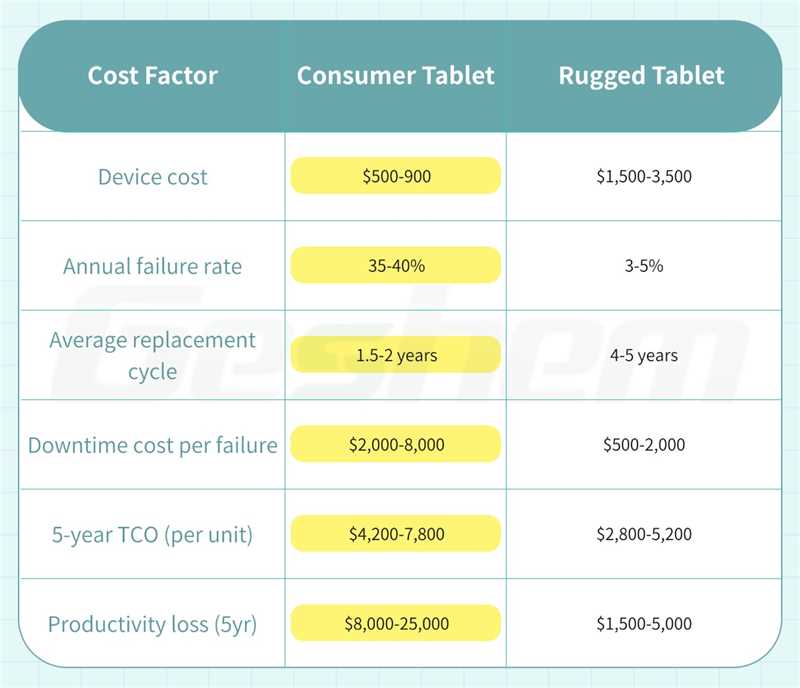
The math is straightforward. Even at 2-3x the initial purchase price, a Geshem rugged tablet delivers lower total cost of ownership within 18-24 months, and the gap widens over the device lifecycle. Factor in the productivity gains from continuous operation (no downtime for device failures), and the ROI case becomes compelling.
Choosing a rugged tablet isn't about picking the most expensive or feature-rich model. It's about matching device capabilities to operational requirements. Here's a simplified framework:
Ⅰ.Define the environment: IP rating, temperature range, ATEX requirements
Ⅱ.Map the workload: Processor, RAM, storage, display size, and brightness
Ⅲ.Identify connectivity needs: Wi-Fi, cellular, serial, docking requirements
Ⅳ.Calculate TCO over 5 years: Include device cost, failure rate, downtime, and productivity impact
Ⅴ.Validate with a pilot: Deploy 5-10 units for 30-60 days before committing to a full rollout
Geshem offers pilot programs and configuration consulting to help teams navigate these decisions. Whether the application calls for a Geshem rugged tablet, a Geshem panel PC, or a Geshem embedded PC, the selection process should be driven by operational requirements—not by spec sheet comparisons.
Shenzhen Geshem Technology Co., Ltd. is a national high-tech enterprise with thirteen years of experience in the industry. It focuses on the research, design, intelligent manufacturing and sales services of industrial computers, industrial tablet PCs and rugged tablet PCs, and has been granted 92 patents (including 27 invention patents).